It's easier to rate 5/5 than 10/10
The ratings game
The Mykonos hotel manager asked me to rate the hotel on Booking.com. Everything was fab. 8 felt like a downgrade, 10 felt excessive so I settled on a 9.
A few days later, it was time to rate the Airbnb in Athens. Everything was fab again. So I rated 5/5. Had this been Booking.com, I would have rated 9/10. That’s when I realised that it’s easier to rate 5/5 than 10/10.
It shows up in Airbnb ratings too. Keep reading —>
 Mykonos is great. But my pecking order would be Naxos ~ Crete > Santorini >> Mykonos.
 Athens looks like Udaipur without its lakes
Politeness tax leads to high median ratings
When you are rating an Airbnb, you are rating the host as much as you are the property. It is “Athina’s apartment with a sea view” on Airbnb whereas it is “Sea view room in an apartment hosted by Athina” on Booking. So you naturally tend to be polite, and you let a few things slip by.
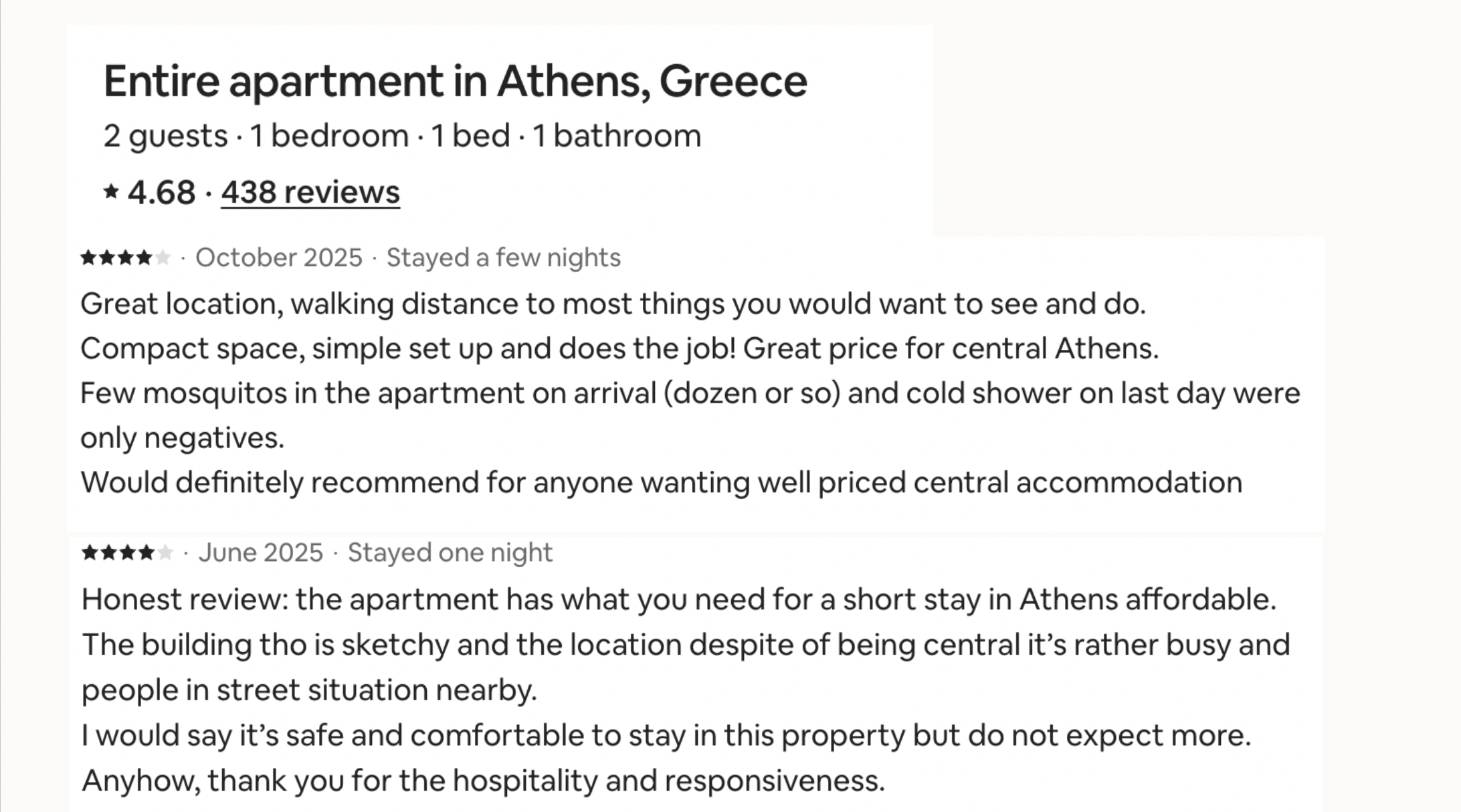
Look at these reviews. Do you think they enjoyed their stay at an Airbnb rated 4.68 (if scaled linearly, this would be ~9.4/10 on Booking.com)?
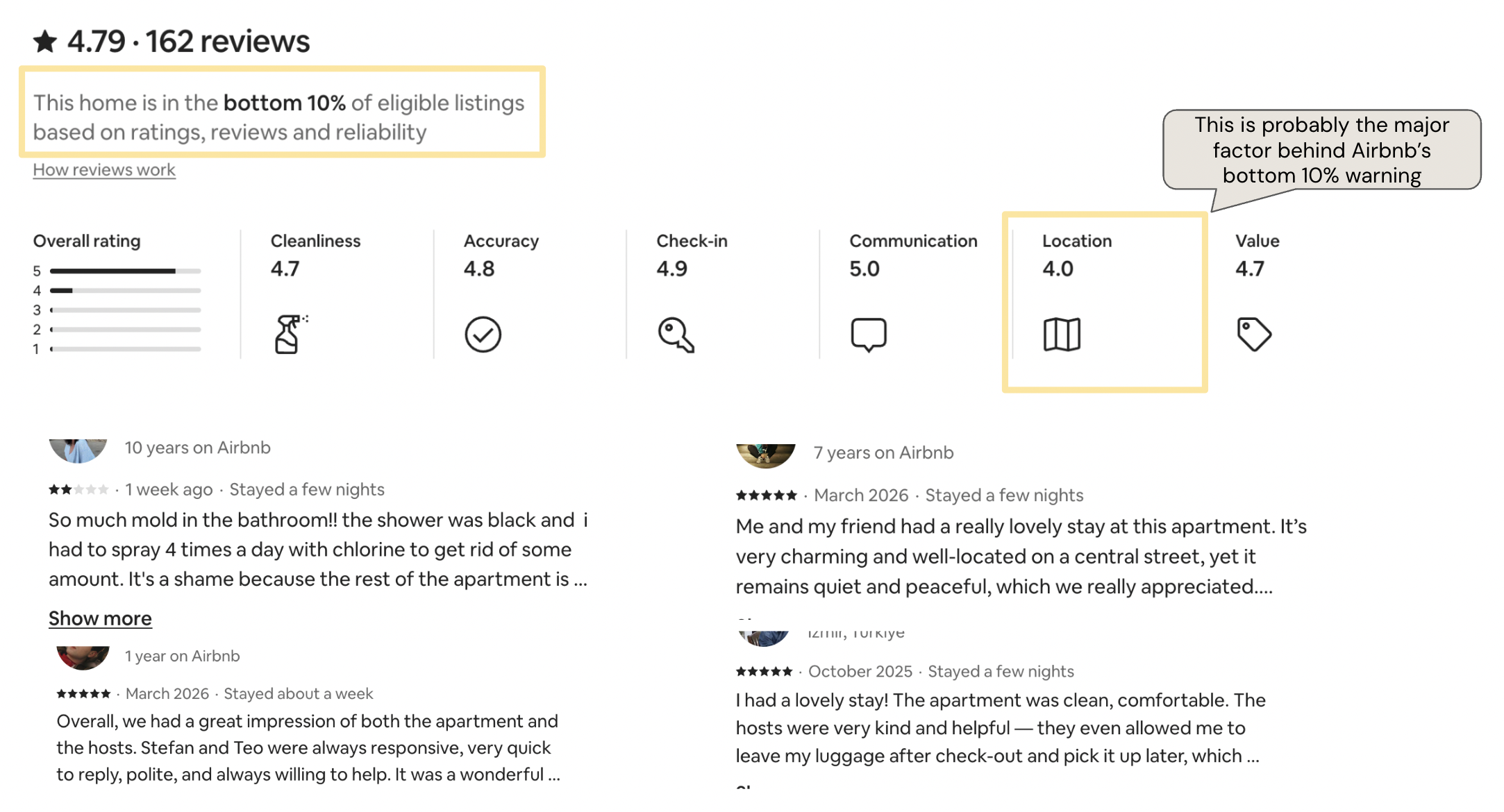
Here’s an apartment in Athens that is 4.79, but has been classified as being in the bottom 10%. 3/4 of recent reviewers gave it 5 stars. It’s not obvious that the apartment is poorly located, which is probably the major factor behind Airbnb’s warning.
Here is what the overall distribution looks like across all Athens listings. Nearly everything is north of 4.5, and a median of 4.87. The scale is a 0.5-point range dressed up as a 5-point one.
Athens Airbnb ratings distribution
13,241 rated listings out of 15,584; median 4.87, mean 4.76.
Airbnb’s 2025 report said guest favourites on average are at 4.92. The same report mentions that 4.75 is the average listing rating. So the average becomes a guest favourite in a gap of 0.17 points on the scale. Let that sink in!
And we have experienced it: you would be hesitant to book an Airbnb rated 4.2, but you would not hesitate to book the same room on Booking.com if it were 8.4, which is 4.2 x 2 (the Airbnb rating linearly scaled). These ratings don’t scale linearly. Our perceived ratings are very different than the mathematical ratings.
Mathematical vs. perceived ratings
For Airbnb, each 0.1 point difference is harder to achieve as you get closer to 5. The percentage difference at each 0.1 interval drops down closer to 5. Mathematically, a 5.0 rated Airbnb is ~2% better rated than 4.9 and 4.1 is 2.5% better rated than a 4.0. But in reality, the 5.0 rated Airbnb might be 2x better than the one rated 4.9. And the one rated 4.1 might be 20% better than than the one rated 4.0.
If Airbnb did an experiment in which they sent someone to all Airbnbs and askd them to compare 2 of them at a time with the question: how many times better was one than the other? Not 4.79 versus 4.99. Just - was this one twice as good? Or 5 times as good? Or 20%? The actual quality delta in mathematical vs. perceived ratings might look like this —>
Airbnb
The perceived curve accelerates around 4.7-5.0, where Airbnb ratings become most compressed.
The magic here is - as we get close to the 4.7s, the % difference in ratings reduces but the perceived rating multiplier goes up. Perceived rating multiplier is illustrative
To sum up
Summarising my Greek holiday here:
- A rating out of 5 doesn’t scale linearly to a rating out of 10. 4/5 is not the same as 8/10 - it is probably 5-6/10.
- Rating hosts instead of properties causes rating inflation on Airbnb. In some cases, Airbnb has to intervene to make sure people don’t get deceived by the rating number.
- The difference between a 4.79 and a 4.99 is not just 0.2 points or 5%. The 4.99 apartment is likely 2-3 times better than the one rated 4.79.
Appendix - The link between IMDb and Airbnb ratings
The last point got me thinking about the IMDb ratings. They behave in a very similar fashion. A movie rated 9 or so is exponentially better than a movie rated 7 or so. So I conducted an experiment, and rated 114 movie pairs to find out my perceived rating multipliers. You can try it out here too: https://true-imdb-scale.lovable.app/. Here are my results:
IMDb
The IMDb curve is gentler: the scale has more headroom, so each visible jump does less work.
Another post on the IMDb ratings coming hopefully soon. Stay tuned!